
Kia Sportage: Blower / Field Effect Transistor (DATC) Repair procedures
Kia Sportage QL (2015-2026) Service Manual / Heating,Ventilation And Air Conditioning / Blower / Field Effect Transistor (DATC) Repair procedures
| Inspection |
| 1. |
Turn the ignition switch ON.
|
| 2. |
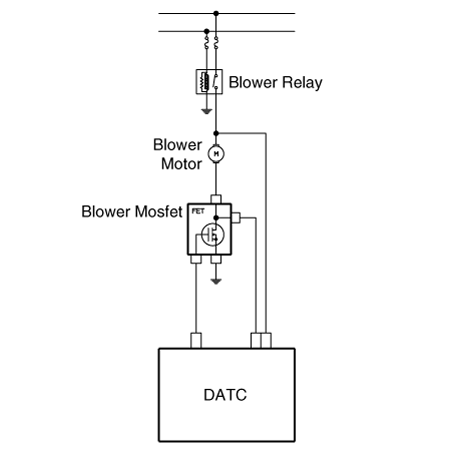
Manually operate the control switch and measure the voltage of the blower
motor.
|
| 3. |
Operate the control switch to raise the voltage up to high speed.
Specification
|
| 4. |
If the measured voltage is not within specification, substitute with
a known-good field effect transistor and check for proper operation.
|
| 5. |
Replace the field effect transistor if it is proved that there is a
problem with it.
|
| Replacement |
| 1. |
Disconnect the negative (-) battery terminal.
|
| 2. |
Remove the glove box housing.
(Refer to Body - "Glove Box Housing")
|
| 3. |
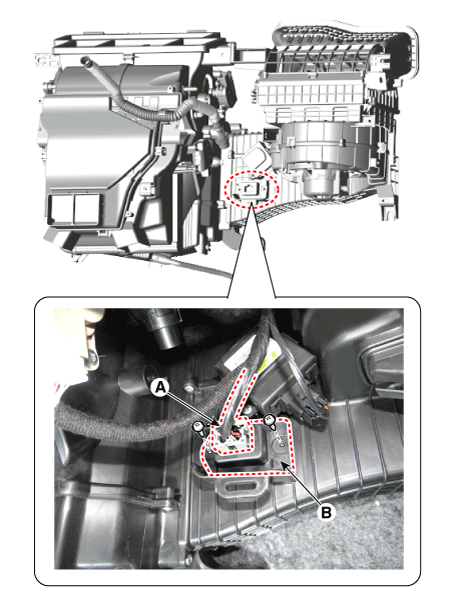
Disconnect the connector (A) and then remove the field effect transistor
(B) after loosening the mounting screws.
|
| 4. |
Install in the reverse order of removal.
|
 Blower Resistor (Manual) Repair procedures
Inspection
1.
Measure the resistance between the terminals.
2.
If the measured resistance is not within specification, the blower resist ...
 Climate Control Air Filter Description and operation
Description
Located in the blower unit, the climate control air filter eliminates foreign
materials and odor. The particle filter performs the roles of an odor filter
as well as ...
Other information:
Kia Sportage QL (2015-2026) Service Manual: Crankshaft Damper Pulley Repair procedures
Removal and Installation 1. Remove the drive belt. (Refer to Timing System - "Drive Belt") 2. Remove the engine room under cover. (Refer to Engine and Transaxle Assembly - "Engine Room Under Cover") ...
Kia Sportage QL (2015-2026) Owners Manual: MAX A/C selection
The MAX A/C mode is used to cool the inside of the vehicle faster. Air flow is directed toward the upper body and face. In this mode, the air conditioning and the recirculated air position will be selected automatically. Instrument panel vents The outlet vents can be opened or closed separ ...
Copyright © www.ksportagegl.com 2015-2026
